The Single Source of Truth That Keeps Every Team Presentation On-Brand Without Policing Anyone
Build brand infrastructure into your tools, not PDFs.
Brand drift is a systems failure, and the fix is infrastructure. When the right colors, fonts, and layouts are built into the tools a team already opens every day, staying on-brand stops requiring anyone to remember the rules. This piece walks through what that infrastructure looks like, why most attempts at it collapse within a year, and how a presentation template, a token file, and one accountable owner can do the job that a 40-page brand guide never managed.
Why staying on-brand keeps failing despite brand guidelines
Almost every mid-size company has lived through some version of the same ritual. That cycle is evidence that the solution was never built to hold.
A guidelines PDF, no matter how well designed, is a one-time instruction manual applied to a problem that regenerates daily. Superside's 2026 guide on scaling design systems for enterprise brands makes the mechanism explicit: without a centralized source of truth, designers and developers end up searching for, rebuilding, or arguing about brand standards instead of just producing on-brand work from the first draft.
The output is inconsistent because thirty people are independently solving a design problem nobody gave them the tools to solve correctly.
Some teams really do have discipline problems, people who ignore the guidelines even when the right assets are sitting right in front of them. Discipline failures are almost always downstream of a findability failure. Fix the infrastructure, and most of what looked like a compliance problem quietly resolves itself.
What a single source of truth means in practice
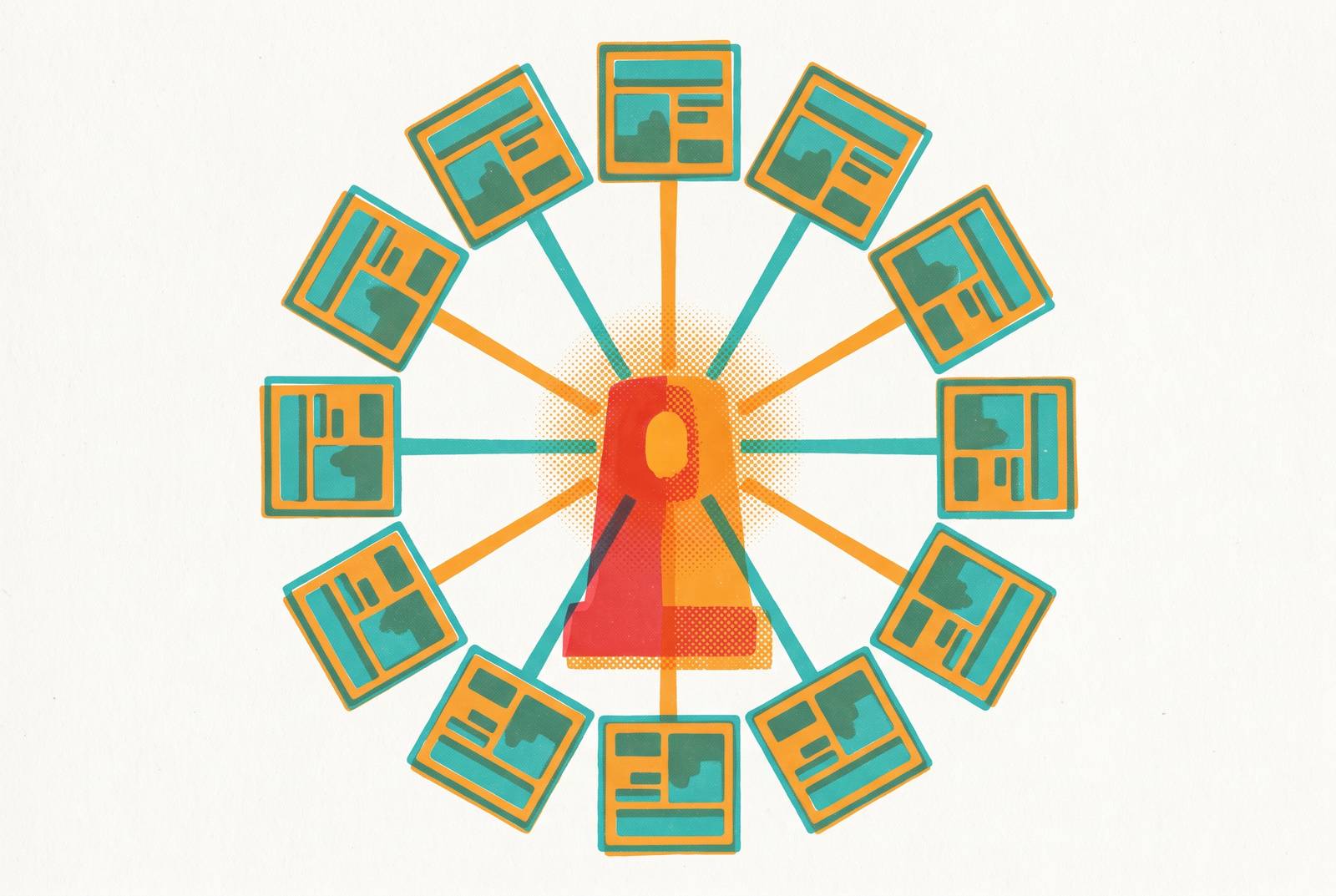
A single source of truth is a governed, living environment where every brand decision, color, type scale, logo lockup, slide layout, has exactly one authoritative home that updates as the brand itself evolves. Superside's enterprise design systems guide frames it as the combination of tokens, reusable components, patterns, brand rules, and documentation that together make up a brand's design language, all centralized and kept current in one place rather than scattered across whoever happened to save the file last.
The operational gap between this and a traditional style guide explains why one approach scales and the other doesn't: a style guide tells a person what to do. When the brand refreshes a color or rolls out a new logo lockup, that change needs to ripple through every downstream template and asset automatically, instead of triggering a team-wide re-education campaign that half the company will miss anyway.
What actually constitutes a working source of truth comes down to a short list of parts, each doing a different job. Documentation that lives and updates in real time rather than a static file that lags the brand's actual current state by months.
Brandworkz's 2026 guide to brand management software for distributed teams draws a sharp contrast with what happens in the absence of this setup: assets scattered across shared drives, guidelines trapped in outdated PDFs, and regional offices guessing at which logo file is the current one. The source of truth ends it.
How design tokens make brand consistency automatic
A token is just a named variable: a stored value for a color, a font size, a spacing increment, referenced by name instead of re-specified every time someone builds something new. That's the entire concept. The power isn't in the definition, it's in what happens once every template in a company references the same token library instead of each designer eyeballing a hex code from memory.
Penpot's guide to design tokens for enterprise teams describes the mechanism cleanly: tokens create one centralized library where every color, font size, and spacing value has a single authoritative source, which prevents the fragmentation that happens when different teams build their own style guides in isolation. Going off-brand actually takes more effort than staying on it, since someone would have to deliberately override a value that's already correct.
Picture what this looks like for an actual person on an actual Tuesday. A sales rep opens a pre-built presentation template. When the brand team updates a primary color six months later, that single token updates everywhere it's referenced, across every template and component in the system, with no manual find-and-replace across hundreds of files scattered across hundreds of laptops. Penpot's guide offers a concrete case: a large grocery retailer manages brand values across its website, social media, landing pages, and email from one central location, rather than maintaining four parallel, slowly diverging versions of the same brand.
This isn't a hypothetical confined to small design teams either. If the approach holds at that scale, it holds for a 40-person sales org.
Standardization affects whether tools and templates stay interchangeable as the brand scales. A token file written to that spec can now drive design tools and production platforms from a single source. Tokens have moved from a loose convention that different teams implemented differently into something closer to a cross-platform standard. That shift compounds the onboarding benefit too: a new hire gets access to every approved brand decision through the token layer on day one, instead of spending weeks learning by trial and error which gray is the correct gray, then quietly redoing work after guessing wrong.
How design systems collapse after launch
A source of truth only stays trustworthy if someone treats it as a living product rather than a one-time deliverable, and most enterprise design systems don't fail at launch.
Superside's 2026 guide names three specific failure modes, each taken at face value here. Organizational complexity is the first: distributed teams making their own design calls under their own local priorities drift from the system gradually, without any single moment where anyone notices it happening. The system still technically exists. It just doesn't function.
The fix for all three is governance treated as infrastructure. Superside's Creative Director of Web Services puts it bluntly: "You can't just launch your design system and hope for the best." Design systems are living products, and they need maintenance, internal buy-in, and ongoing communication to survive past their first few months.
Two concrete mechanisms do most of the governance work. And approval workflows get built into the system itself rather than bolted on as an afterthought: Brandworkz describes configurable review and approval steps that track every asset before it ships, cutting the odds that something outdated reaches an audience without requiring a human gatekeeper to catch every single file by hand.
What non-designers need to produce on-brand output
None of this matters if the only people who can operate the system are designers. That's the whole test, really: does a source of truth make staying on-brand automatic for the salesperson, the marketer, the chief of staff, people with zero design training and a deadline in forty minutes? If the system requires design fluency to use correctly, it hasn't solved the original problem. It's just moved the bottleneck.
What a non-designer actually needs, in practice, comes down to a short set of things. Lockable templates that pre-structure the output, not a blank canvas with the right brand colors loaded onto it, but an opinionated layout where the decisions most likely to go wrong have already been made for them. A brand kit that travels with the tool itself, uploaded once, logo, colors, typeface, approved imagery, so every new asset inherits those values rather than getting copied and tweaked from whatever file happened to be handy.
The AI layer is where this scales to every seat in the company rather than staying confined to whoever has template access memorized. Done that way, the AI operates inside the governed system instead of next to it, generating variations and formats that are already on-brand by construction. That's a meaningfully different output than a raw AI draft that still needs a designer to go back and fix the font, the spacing, and the logo placement after the fact.
The sales presentation case: the source of truth under real production pressure
If there's one place to stress-test whether any of this actually holds up, it's the sales deck. Sales presentations get built under real time pressure, usually by people with no design background, for an audience that forms an impression of the company's credibility within the first ninety seconds of the screen share. It's the single highest-pressure, lowest-design-oversight environment most companies have, which makes it the honest test case.
What the source of truth needs to enforce here is specific. Locked slide count and section order, so building the right fifteen-slide deck is the path of least resistance and building an overlong, rambling one takes active effort to produce. The brand layer stays fixed underneath it.
This is where a weak brand presence actually costs something measurable, not in some vague reputational sense but in the literal flow of a sales conversation. If a deck looks like it came from a different, smaller, less serious company than the one on the call, the rep spends the first several minutes reassuring the prospect that the company is real and capable, time that should have gone toward the actual value proposition instead.
There's evidence this approach scales well beyond a single sales team too. Superside's work with EdTech firm D2L, on its Brightspace product, produced a large volume of unique ad variations in a fraction of the time traditional production would have taken, with AI handling resizing and variation while the underlying design system kept every single asset aligned to brand standards.
The hybrid model: one in-house design lead plus a governed system
Zoom out from presentations and the same infrastructure answers a bigger question: can a company run brand execution in-house without constant outside help, or does it need an agency on retainer forever? The source of truth determines the answer. With it, non-designers produce on-brand output on their own, and the one person actually trained in design spends time on the system itself.
But the honest counterargument deserves a real answer, not a dismissal. Keurig Dr Pepper shut down its in-house creative agency, Liquid Sunshine, in 2025 and went back to working with outside agencies. That's a real data point about the limits of going fully in-house, not an exception to explain away.
What most growth-stage companies seem to be landing on instead is a hybrid: one in-house design lead who owns the brand, the design system, and its roadmap, with outside partners brought in for surge capacity, specialist craft, or simply a second creative opinion when the internal view has gotten too close to the work. External partners build from the same governed templates and the same token system the internal team uses, so what they deliver comes back on-brand by default instead of kicking off a correction cycle after the fact.
Building the source of truth as infrastructure: a starting point for teams without one
The strongest design systems don't launch complete. They start lean, nail a small core, and grow from there. The teams that struggle are usually the ones treating the whole thing as a waterfall project with a launch date circled on a calendar, rather than a living product with an owner and a roadmap.
A practical build sequence runs in five steps. Establish the token layer first: define the core brand decisions, primary palette, typeface, spacing scale, as named variables before a single template gets built, since this is the foundation everything else will reference. Resist the temptation to build everything at once. Superside's design systems guide points to unclear ownership, alongside weak documentation and inconsistent implementation, as one of the most common reasons design systems stall out or fail.
Replace static PDFs with living guidelines, documentation that updates in real time, so when the brand changes, the team sees it immediately instead of inheriting whatever version was saved to the shared drive eight months ago. And configure the AI layer to operate inside the system rather than beside it: brand kit uploaded once, template prompts that encode tone and structure, a single human review pass before anything goes live. AI generating from within the source of truth extends the system to every seat in the building. AI generating outside it just creates a second, ungoverned stream of output that someone will eventually have to clean up.
Superside's enterprise design systems playbook calls this an MVP mindset rather than a waterfall one: start with consistent core components, tokens, typography, and brand colors, plus a handful of reusable templates, then launch, stress test, gather feedback, and grow from there. Once that loop is running, staying on-brand becomes a property of the tools the team was already going to use anyway, not a behavior they have to maintain through willpower. Nobody has to police anything, because the easy path and the on-brand path have become the same path.