Why AI Content Tools Break Brand Consistency and How a Locked Kit Fixes It
A locked brand kit keeps AI from creating dozens of slightly different versions of your voice.
Large language models forget everything the moment a session ends, and that single architectural fact explains most of the off-brand slide decks, mismatched carousels, and oddly-voiced one-pagers flooding marketing teams right now. The tools are stateless by design, not careless. Every new chat starts from zero unless something outside the model itself is doing the remembering.
Why AI content tools cannot hold a brand
Statelessness is not a bug that a patch will eventually fix. A model has no idea that the last person who used it just spent twenty minutes correcting its tone, unless that correction was captured somewhere and fed back in.
That creates the first failure mode, prompt-dependency. Consistency depends entirely on how well one person, in one sitting, describes the brand to the machine. Multiply that by forty people across sales, social, and field marketing, each typing their own version of "make this sound like us," and the brand splinters into forty slightly different brands wearing the same logo.
The second mechanism is subtler, because the landscape shifted underneath it recently. Base models are stateless, but the consumer products built on top of them are not necessarily stateless anymore. So the gap between "the AI remembers nothing" and "the AI remembers everything" is a patchwork, tool by tool, and that patchwork is itself a governance problem, because a brand team cannot assume uniform behavior across the five AI tools its employees happen to be using this quarter.
A third mechanism makes the first two worse. Call it volume cover. Speed does not cause drift by itself, but speed is what keeps drift invisible long enough to compound.
Adobe Experience League's 2026 analysis frames the whole situation as a coordination failure rather than a quality failure: each AI tool encodes brand intent in its own way, and without a shared layer connecting interpretation, enforcement, and learning across those tools, multiple teams end up producing independent, compounding versions of drift. The AI is generating content that reads perfectly well on its own and still happens to be semantically off-brand in ways no rules-based checker catches, because nothing about the sentence is wrong, only everything about whether it sounds like the company that supposedly wrote it.
The speed limit of brand guidelines against AI
Most brand guideline documents were built for a world with one or two content channels and a small enough team that everyone absorbed the house style by osmosis. AI did not widen that trickle. It turned it into a flood, and PDFs do not scale to floods.
Consider a single voice directive, something like "conversational with clear authority." None of these interpretations is wrong exactly, but none of them match, either, and every handoff between a document and a human (or a document and a model) is its own small act of translation, with its own small chance of drift.
The review step was always the safety net underneath this translation problem, and it was never a particularly strong net to begin with. Marketing creates content faster than a brand manager can review it even in slow quarters. Deadlines force people to skim instead of read, and skimming is exactly the condition under which a slightly-off headline slides through unnoticed.
Then there is the problem nobody puts in the brand deck: documents cannot learn. A brand guideline is accurate on the day it is published and starts decaying the moment a new campaign shifts what the brand should sound like next. The PDF has no way to notice that shift, no way to reason about why it happened, and no mechanism for updating itself. It just sits there, technically still true, increasingly irrelevant, waiting for someone to notice the gap and schedule a redesign meeting eighteen months from now.
Who bears the cost when brand drift compounds
Go-to-market teams take the brunt of this because they sit furthest from design oversight while producing the assets prospects and customers see most often. A field marketer knocking out a regional one-pager has no designer anywhere in the loop to catch what slipped.
Each of them prompts the AI tool differently, because each of them is a different person with a different mental model of what "on-brand" means, and each produces a slightly different result. None of these results is catastrophic on its own. That is precisely the problem.
Small, independent drifts do not stay small. A brand does not die from one bad deck. It erodes from a couple hundred decks that are each mostly right, but each wrong in a slightly different direction.
The architecture of a locked brand kit
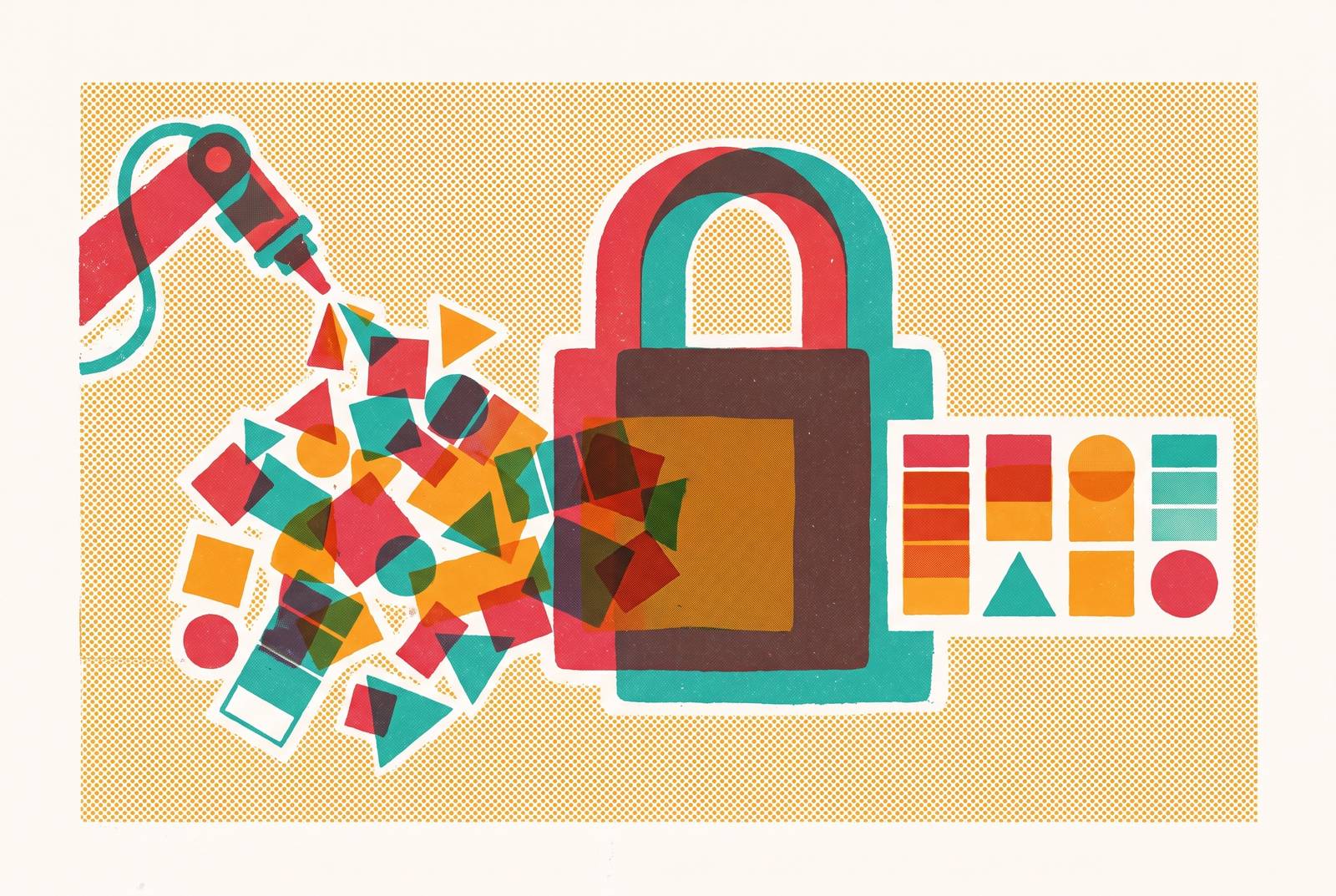
The fix is not a better set of instructions, because instructions break down at volume. A locked brand kit works by moving the brand's rules out of the instruction layer and into the environment itself, so the constraints travel with the asset rather than depending on whoever happened to type the prompt that day.
That is a meaningful shift in where governance sits inside the workflow. Traditional brand review happens at the back end: content gets made, then somebody checks whether it's on-brand, then it either ships or bounces back. A locked kit moves that checkpoint to the front end. Fonts, colors, logo placement, and layout structure get fixed at the workspace level before anyone opens a blank canvas. The off-brand version was never an option to begin with.
Three components do this work together. And together these two pieces produce something genuinely useful: AI stops being the source of inconsistency and starts being the thing that enforces consistency, because it is now operating inside guardrails rather than guessing at them.
That reframes what AI was doing wrong in the first place. The tools were never diluting strong brands. They were exposing brands whose documentation had never been specific enough to survive contact with a machine that takes instructions completely literally.
Making brand rules specific enough for AI
None of the architecture above means anything if the rules being locked into it are still written the way most brand guidelines are written, which is to say, in adjectives. "Friendly, bold, trustworthy" cannot be enforced by a template, by a locked color palette, or by an AI model, because none of those things know what "bold" means in a sentence. Behavioral rules can be enforced. Adjectives cannot.
A useful test: could a new hire, or for that matter a language model, follow the rule without needing to ask a clarifying question? The specific version survives contact with reality: use contractions, write in second person, keep sentences under 25 words, cut the jargon. Same logic applies on the visual side. "Stay visually on-brand" is an aspiration dressed up as an instruction. Primary color hex codes, a no-gradients rule, photography instead of illustration, and a minimum logo clear space are instructions a template can actually enforce.
Where do these specific rules come from? Not from a wishlist of how the brand would like to sound someday. A guideline built from aspiration rather than evidence creates its own kind of drift, because the document describes a brand voice the company has never actually used, and employees quietly default back to whatever sounds natural instead.
One more piece belongs in this document, and most style guides skip it entirely: a list of what's forbidden. Brand Kit OS frames this as defining rules rather than aspirations, concrete and enforceable rather than subjective, and the forbidden list is often what does the heaviest lifting, because it is the thing standing between a locked kit and the AI model's cheerful, generic default voice.
The human review step in an AI-governed workflow
The strongest pushback against any of this goes something like: companies already have beautiful, detailed brand guidelines, and off-brand content still ships constantly, so what makes a locked kit any different from the PDF that's already failing?
The objection is fair, but it conflates two separate problems. A kit that encodes specific, machine-readable constraints and lives inside the actual creation environment is a different object than a PDF on a shared drive, even if the words inside it look similar. The PDF waits to be consulted. The kit is just there, running, every time someone opens a new file.
What that locked environment produces is AI drafting at scale with a human who owns the brand editing for nuance, accuracy, and taste before anything ships, and placing governance this early means the real decisions get caught before they reach that final edit. Governance belongs at the briefing stage, at the moment of creation, and at adaptation into new formats, not exclusively at a final sign-off that happens after all the real decisions were already made.
A locked kit does not remove the human reviewer. It shrinks what that reviewer has to look for. Fonts, colors, and layout are no longer on the table, because the environment already settled those questions. A kit cannot do that work. It was never supposed to.
What a brand kit needs beyond colors and fonts
A kit that only locks visual parameters is a reasonable start and an incomplete solution. Voice is harder, and voice is where most of the actual brand erosion happens.
Continuous learning closes the loop: the system captures what messaging actually performs and feeds that back into the rules, so a pattern that keeps generating the same correction triggers an update to the rule itself rather than a hundredth repeat of the same manual fix.
Adobe Experience League's 2026 analysis describes the end state as a brand intelligence layer, something that encodes what the brand actually means, enforces that meaning at every stage of the workflow, and learns from what happens after content ships. The contrast it draws is pointed: static governance just keeps enforcing rules that were correct two years ago, with no mechanism for noticing that two years have passed. That gap between "correct once" and "correct now" is the entire argument for treating this as a living system instead of a document.
Implementing a locked kit without a design team
Here is the practical problem with everything above: the teams suffering the most from drift, sales reps, social managers, field marketers, are exactly the teams least likely to have a designer sitting next to them. Which makes the kit's self-enforcing quality the single most important thing about it. If consistency depends on the person using the tool having design judgment, these teams lose by default.
The sequence that follows from the argument runs in four steps. Second, have one designer, or a design-literate operator who understands layout and type, build the locked templates a single time. Those templates then carry the governance work for every asset built inside them afterward, so the person using the template never needs to know what a kerning value is.
Third, lock fonts, colors, and logo usage at the workspace level so that no individual session can override them regardless of how the AI was prompted that day. An easy way to work outside the locked environment is a door drift finds immediately.
MarcomCentral's guide calls approved templates "a huge step in the right direction," and separately notes that templates lock in typography, colors, and layout structures so AI-generated designs stay visually consistent, small edits still happen, but the structural drift that used to compound asset after asset gets cut off at the source. When a template keeps generating output that needs the same correction over and over, that is a signal to fix the template, not a signal to add another layer of review. The goal is a system that gets more accurate the longer it runs, not one that just gets more people checking its work.